Ecolation a Blue Ocean Strategy Company (1/2)
The case Ecolation
After applying the methodologies described further down in the following article, Ecolation resulted as a company with a highly disruptive business model, able to create its market in a highly non-competitive segment of the building material domain and a management that is ready to overcome early stage corporate challenges.
Also a very early stage company that still has to move from TRL2 to TRL3 (Technology Readiness Level) even more so it is important to conduct a valid spot analysis.
Why Disruptive?
Blue Ocean preseed - competitive analysis:
The insulation market is dominated by large, established manufacturers with strong production capabilities and global distribution networks. Within this landscape, companies can broadly be categorized along two strategic dimensions: ability to execute and completeness of vision. Here we use the Magic Quadrant approach developed by Gartner INC.

Ecolation: Capturing CO2 in every building worldwide.
Industry leaders:
Major manufacturers such as Rockwool, Knauf, and Kingspan dominate the insulation market through large-scale production, mature supply chains, and well-established global distribution networks.
Their competitive advantage lies primarily in operational scale, manufacturing efficiency, and distribution reach, while product innovation typically focuses on incremental improvements to existing insulation technologies.
Often high fixed investments, heavily immobilized capital and related high shareholder expectations are hindering true innovation since all stakeholders like to see that maximum profitability is captured from the existing productive infrastructure.
Challengers:
Companies such as Steico and Isover operate with strong market positions in specific segments of the insulation industry. Their strategies focus on expanding and optimizing existing material categories, including wood-fiber insulation and advanced glass wool products, rather than introducing fundamentally new material concepts.
Niche players:
Specialized manufacturers such as Isocell and Gutex concentrate on ecological or natural insulation materials targeting specific market niches. While these companies demonstrate strong sustainability credentials and product specialization, their production scale and market reach remain limited compared to large industrial competitors.
Visionaries:
Companies in the visionary quadrant focus on developing next-generation insulation technologies that aim to improve sustainability, material performance, and manufacturing Efficiency.
One example is CleanFiber, a U.S.-based manufacturer of advanced cellulose insulation designed to improve material consistency while reducing dust and contamination compared to conventional cellulose insulation. Despite these innovations, many approaches remain evolutionary extensions of existing insulation materials rather than fundamentally new material architectures.
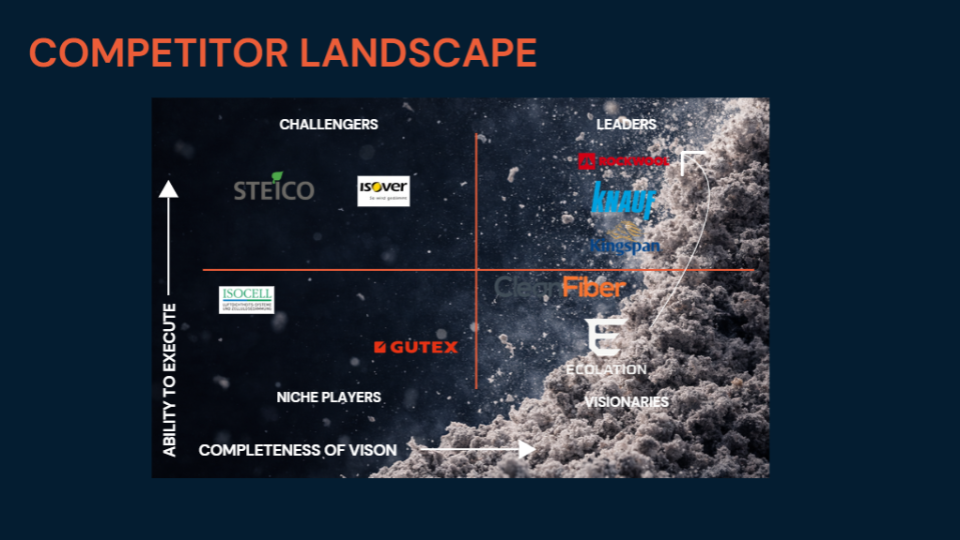
The Gartner Magic Quadrant applied to Ecolation.
Ecolation a Blue Ocean Case
Ecolation currently occupies the visionary quadrant, reflecting the company’s strong technological innovation combined with its early stage of industrial development.
Rather than optimizing existing insulation materials, Ecolation introduces a CO2-mineralized cellulose insulation material designed to integrate carbon directly into the insulation structure while maintaining & increasing competitive thermal performance, fire safety, and durability.
This material architecture represents a fundamentally new approach to insulation, enabling buildings to function as long-term carbon storage systems while remaining compatible with established construction practices. As the technology progresses through certification and industrial scale-up, Ecolation aims to transition from the visionary quadrant toward a leader position within the emerging category of carbon-negative building materials.
The management and VGG-Sphere-Analysis-360© in preseed
With a team and its background as described further down in this blog, the early stage management is highly competent in their related fields including profound experience in theory and practice:

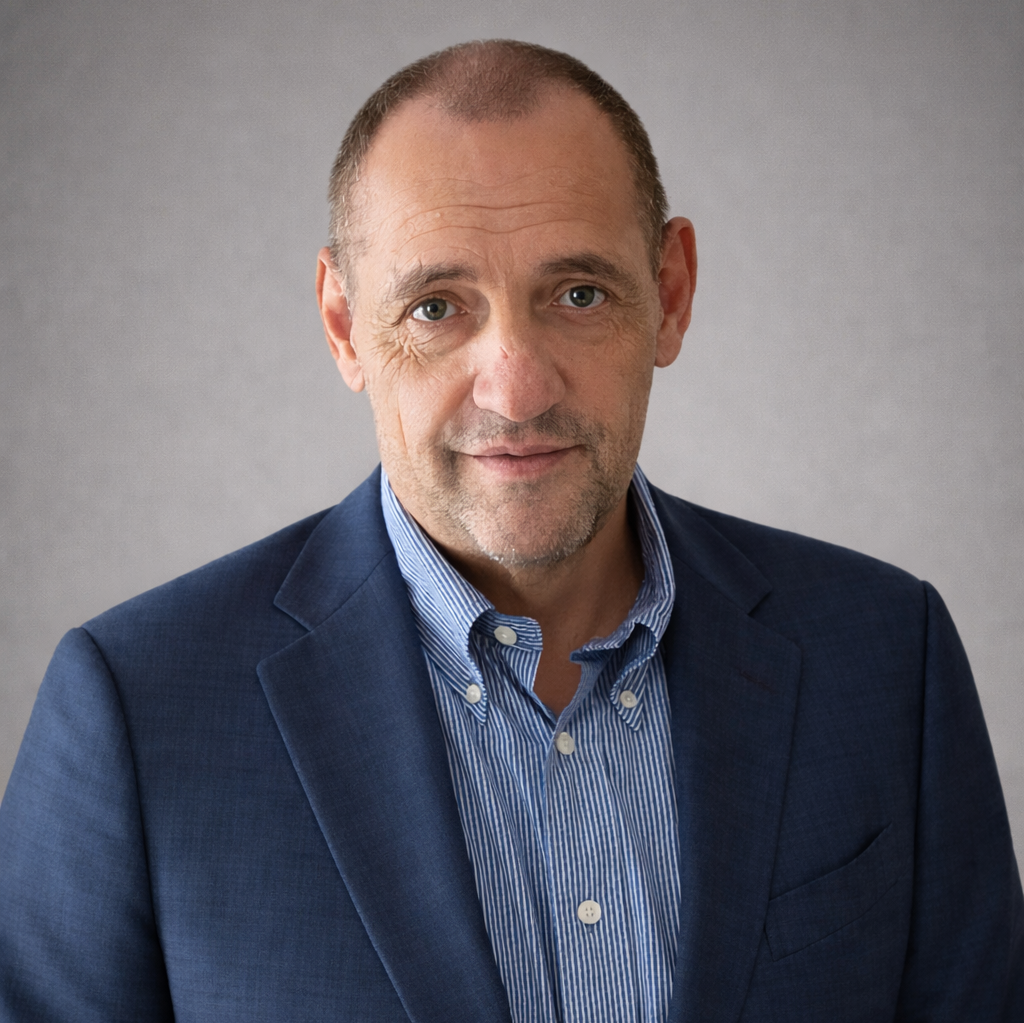
The Ecolation: Team building hands on the insulation material of the future by captioring & storing actively CO2.
Dr. Abbas Beheshti Askari is the Chief Scientific Officer and his background is in materials science and catalysis, with strong expertise in the synthesis of inorganic materials, their chemical and structural characterization, and the systematic improvement of material properties based on performance-driven insights. His work has consistently focused on understanding how materials behave under real operating conditions and using this understanding to guide rational material design.
Abbas conducted his doctoral research at the Max Planck Institute for Chemical Energy Conversion (Max Planck Society), where he worked on the synthesis and performance optimization of heterogeneous catalyst systems. His research combined experimental design with advanced characterization to link structure, composition, and function, forming a solid foundation for translating laboratory concepts into robust materials.
Previously, he worked as an R&D Scientist at BASF, contributing to industrial catalyst development, including material synthesis, performance evaluation, and scale-up-relevant considerations. He has also been affiliated with Helmholtz-Zentrum Berlin, where he contributed to research on functional materials for energy-related applications.
Dominik Thiel is the CEO and he earned a Bachelor’s degree in Industrial Engineering at the Technical University of Berlin, specialising in Energy & Resources. During his studies, he increasingly focused on the role of materials and industrial systems in global emissions, and concluded that scalable solutions must be built where value is created: In companies and supply chains.
To deepen his ability to translate sustainability into scalable business execution, Dominik pursued a Master’s degree at ESCP Business School, specialising in Sustainability, Entrepreneurship & Innovation, where he formed the initial idea for Ecolation.
Torsten Reiss is the CFO, holds a Phd from the Universita’ degli Studi di Bologna and he is a finance and operations leader and Managing Partner at Reiss Consulting LLC, with a background spanning capital markets, board-level leadership, and hands-on scaling across Europe and the US.
Torsten started his career in investment banking at Deutsche Bank and later continued in management consulting at zeb and thereafter he worked at former BGP LLC (now EY-Parthenon) & Global Strategy LLC.
In addition, he founded and exited a US-based, Chicago venture within 29 months for a multiple of 42 and held corporate development and finance leadership roles in the US, including franchising and investor relations.

The market potential for real innovation in the building insulation market.
In part 2 I will go deeper into the analysis by applying the proprietary methodologies & toolsets of the D2-Group and the Reiss Consulting LLC that are based on the high profile frameworks of the Blue Ocean Strategy and M. Proters Value Chain.
the Deep-Blue©
the VGCG-Sphere-Analysis-360©
Summary:
To evaluate a startup in ScienceTech & DeepScience specific methodologies & tools need to be applied.
Value in very early stage companies can be analized through new approaches.
When p&l and balance sheet data are mainly assumptions, look at the team, core values and corporate identity.
Advanced approaches based on proven practices: Deep-Blue© and VGCG-Sphere-Analysis-360©.
Investing in ideas is not buying a lottery tickedt but taken advantage of the possibility to arbitrage.