Why Sustainable Insulation Still Struggles to Go Mainstream
For decades, the insulation market followed a relatively simple logic: materials needed to work, comply, scale, and remain cost-competitive. Sustainability, if considered at all, was often secondary.
That logic is now changing.
Buildings are under growing pressure to improve not only their operational energy performance, but also the carbon footprint of the materials they are made from. In Europe, that shift is becoming increasingly visible in both regulation and marketexpectations. The revised Energy Performance of Buildings Directive places greater emphasis on zero-emission buildings and life-cycle thinking, while the broader decarbonization debate is pushing embodied carbon much further into focus. At the same time, buildings remain one of the largest energy and emissions levers in the economy, which makes insulation a strategically important material category.
That sounds like the perfect moment for sustainable insulation materials to break through.
And yet, in most mainstream applications, they still have not.
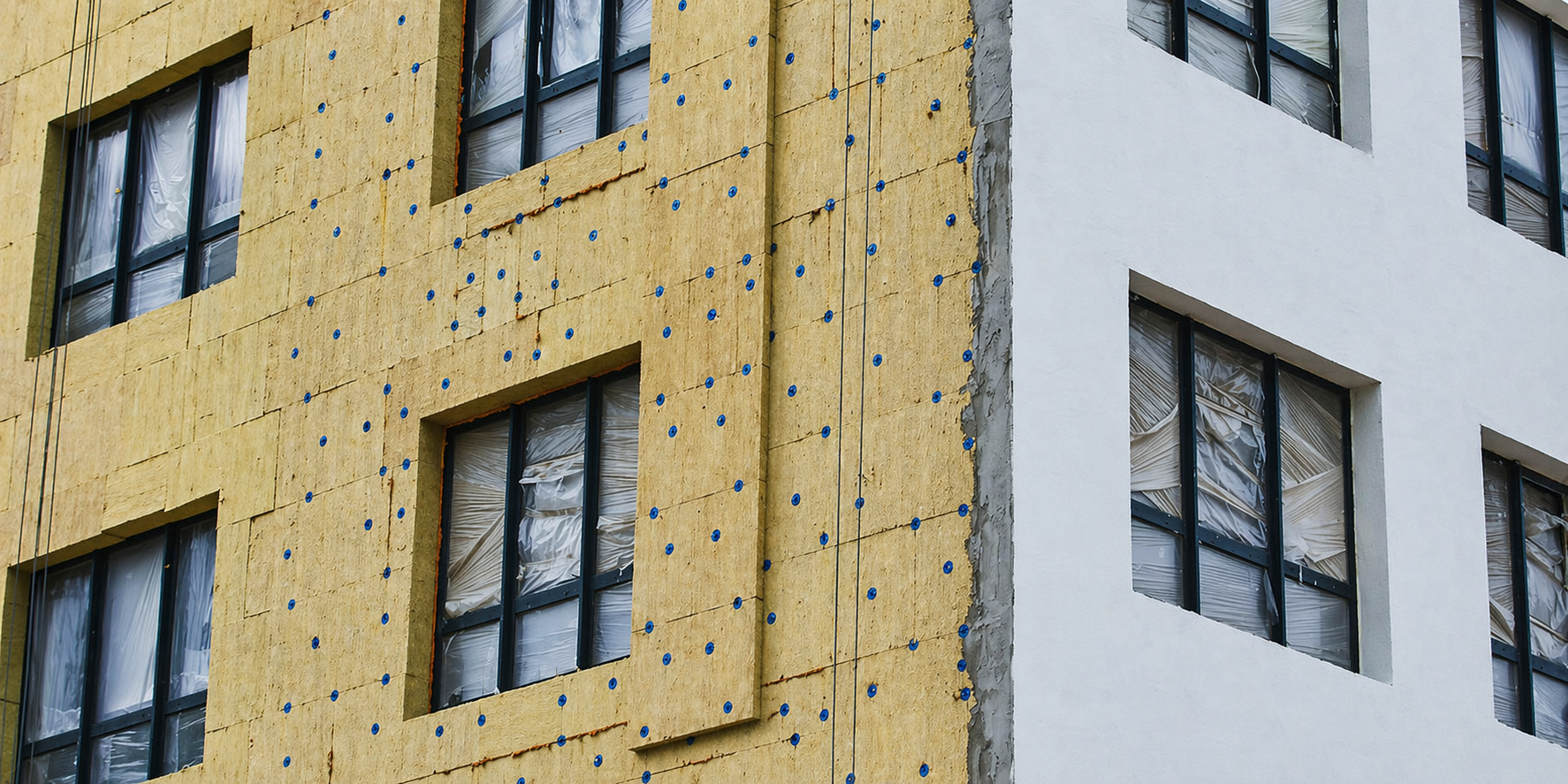
The real market problem is not a lack of interest in sustainability
There is no serious shortage of interest in lower-carbon construction materials. The issue is that the insulation market does not reward sustainability alone. It rewards complete solutions.
To displace incumbent products, a material must usually perform across several dimensions at once:
thermal performance
fire safety
moisture behavior
durability
cost competitiveness
ease of installation
compatibility with existing construction systems
regulatory acceptance
That is where many sustainable alternatives run into difficulty.
Some offer an appealing environmental story, but fall short on practical building requirements. Others are technically promising, but become harder to justify once cost, installation logic, certification pathways, or build-up thickness are taken into account. In other words, many ecological materials are not rejected because the market dislikes sustainability. They are rejected because they still introduce too many trade-offs.
Why “more sustainable” does not automatically mean “more relevant”
A common misconception in the sustainability debate is that a material with renewable or bio-based inputs is automatically the superior answer. In reality, the picture is more complex.
Even public research in Germany points out that renewable raw materials are not always automatically associated with lower climate impacts. Outcomes depend heavily on factors such as processing intensity, density, product format, and application context. In some cases, lighter fibre-based solutions can perform very well from an environmental perspective; in others, heavier and more processed products lose part of that advantage.
The same applies to thermal performance.
Not every sustainable insulation material performs equally well per centimetre of thickness. Mineral wool products on the market can reach declared thermal conductivity values around λ = 0.032 W/mK and achieve Euroclass A1 non-combustibility, while common wood-fibre products are often in the range of roughly λ = 0.036 to 0.040 W/mK and frequently classified as Euroclass E. That does not make wood fibre “bad” insulation. But it does show why replacing incumbent materials in mainstream applications is not simply a matter of ecological preference. It often affects thickness, detailing, fire strategy, and system design.
That distinction matters.
A material does not become mainstream because it is greener in principle. It becomes mainstream when it can meet real-world building constraints without forcing painful compromises elsewhere.
Why incumbent materials still dominate
Established insulation categories did not become dominant by accident. They benefit from decades of optimization, industrial scale, installer familiarity, supply-chain maturity, and deeply embedded specification habits.
That gives incumbent players an advantage that goes far beyond product performance alone.
They know how to serve large projects reliably.
They fit into existing procurement logic.
They are well understood by planners, contractors, and regulators.
And they are available at scale.
This is why disruptive innovation in insulation is harder than it looks from the outside. New entrants are not just competing against a material. They are competing against an entire industrial ecosystem.
That also explains why so much of the market still relies on incremental progress rather than step-change innovation. For established players, optimizing an existing category is often economically rational. But from a climate and materials perspective, that may not be enough.
Where regulation fits into this landscape
Regulation is reinforcing this shift rather than creating it from scratch.
As policy increasingly focuses on life-cycle performance, embodied carbon, and future-proof building standards, insulation materials are being assessed through a broader lens. Operational performance remains essential, but it is no longer the only criterion that matters. Materials will increasingly need to demonstrate not only technical suitability, but also relevance in a more carbon-conscious regulatory environment.
That creates additional momentum for solutions that combine climate value with real-world applicability.
What the market is really missing
The insulation market does not need another product that is merely “greener.” It needs materials that close the gap between climate value and industrial relevance.
That means solutions that do not ask the market to choose between:
low embodied carbon and high technical performance
sustainability and regulatory fit
climate benefit and cost logic
better materials and buildable systems
This is the point where many sustainable alternatives still struggle: they solve one part of the problem, but not the whole equation.
Where Ecolation fits into this landscape
At Ecolation, we believe insulation should be rethought not only as a way to reduce operational energy demand, but as a way to store carbon in the built environment itself.
Our approach is based onCO₂-mineralized cellulose insulation. A material concept designed to integrate carbon directly into the material while aiming to meet the practical requirements required for mainstream relevance.
That market position matters.
Because the opportunity is not simply to launch another ecological insulation product. The real opportunity is to develop a material that combines:
strong thermal performance
a credible pathway toward regulatory and technical viability
compatibility with real construction workflows
economic relevance for broader applications
and a clear climate benefit at the material level
In that sense, Ecolation is not trying to become a more attractive niche alternative. We are working toward something more demanding: a high-performance, carbon-negative insulation solution with the potential to fit the mainstream logic of the construction industry.
The next phase of the market will be decided by completeness
The insulation market is entering a new phase.
Operational energy performance remains crucial. But it is no longer the only metric that matters. Material origin, embodied carbon, circularity, and long-term regulatory resilience are becoming increasingly important in how buildings are assessed and how future-proof products are evaluated.
That changes the competitive landscape.
The winners in the next generation of insulation are unlikely to be the products with the greenest story alone. They will be the ones that combine sustainability with technical credibility, industrial scalability, and real-world usability.
Conclusion
Sustainable insulation has not struggled because the market is unwilling to change. It has struggled because many alternatives still do not solve enough of the market’s requirements at the same time.
That is the gap the industry now needs to close.
The future of insulation will not be built on trade-offs that merely sound good in theory. It will be built on materials that can deliver climate benefit, technical performance, and market fit in one integrated system.
That is the shift we believe the market is moving toward.
And it is exactly where Ecolation aims to play.
Interested in how new insulation materials could reshape building performance and carbon impact?
Explore more on our Technology page or get in touch!
